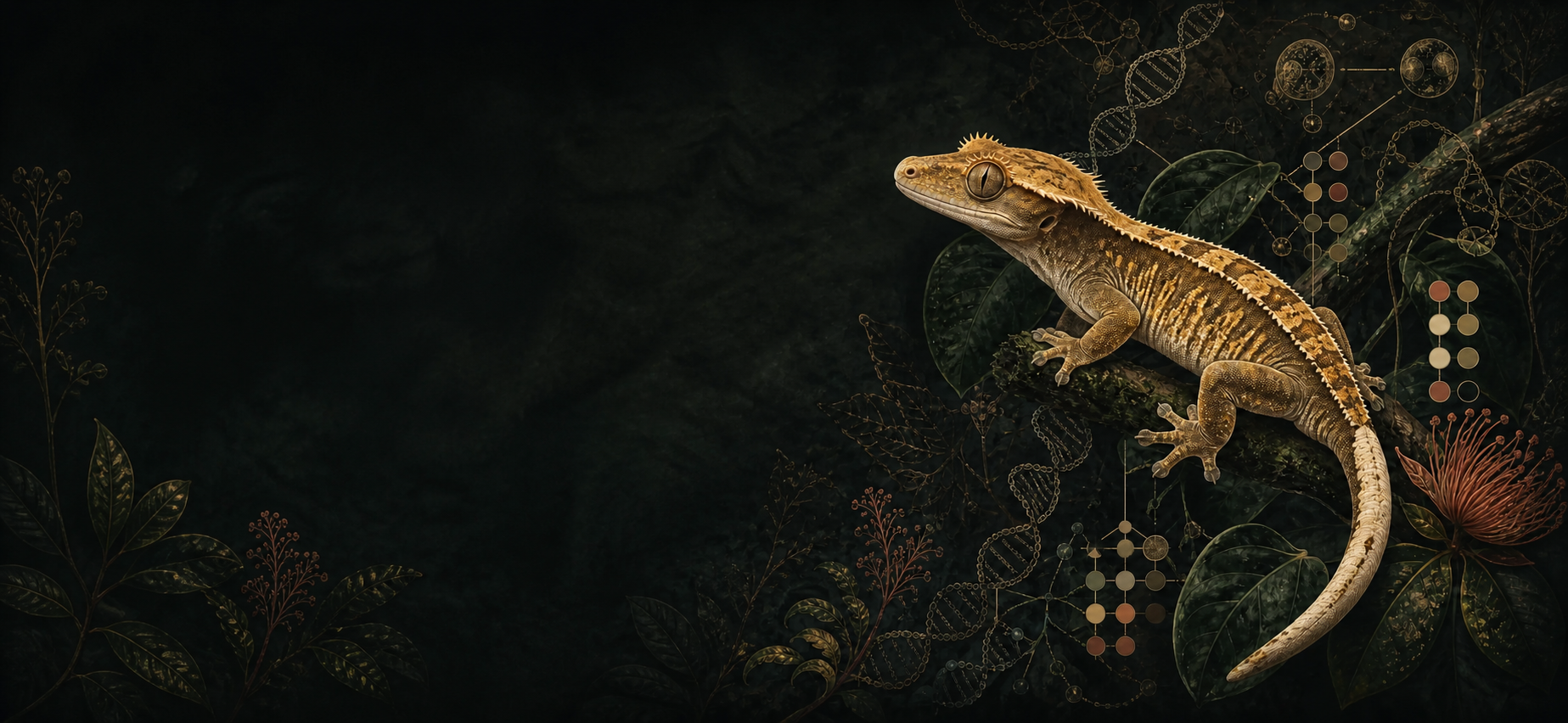
Understanding Crested Gecko Genetics
A morph describes a gecko’s appearance. Genetics helps explain which features can pass from parents to offspring. Start with visible traits, then work through inheritance examples.
Start with the basics ↓Appearance & Inherited Traits
A trait is one feature, such as spots or a stripe. Several traits can appear on the same gecko.
Appearance: the visible features
Color, spots, stripes, and the amount of pattern are things you can describe by looking. The biology word for visible appearance is phenotype.
For example: “a red gecko with spots.”
See six illustrated examples →Genetics: the information underneath
A gecko can carry an inherited version that you cannot see. Its genetic makeup is called its genotype. A photo alone cannot reveal all of it.
For example: a recessive carrier can look like a non-carrier. We’ll explain “carrier” below.
Same gecko, different shade. “Fired up” means its colors look darker or more intense; “fired down” means lighter or less intense. Its inherited information has not changed.
How Genes Pass from Parents
In this simple one-gene example, a baby gets two copies in total: one from each parent. A gene is a stretch of DNA; a version at that location is called an allele.
Inheritance Patterns
- Recessive
- Two copies of the recessive version are needed to show the trait in this model. With just one, the animal is a carrier: it can pass the version on without showing that trait.
- Dominant
- One copy can be enough to show the trait. “Dominant” describes inheritance; it does not mean better, stronger, or more common.
- Incomplete dominant
- One copy gives a visible form; two copies give a different form. A two-copy form is sometimes called a super. That name does not mean healthier or safer.
- Several genes together
- Many colors and patterns reflect several inherited influences. Selective breeding means choosing parents for desired features over generations. Expect a range of looks rather than one simple percentage for the whole appearance.
You can learn to recognize a pattern without knowing its exact genetics. A Harlequin label describes coverage; it does not prove there is one “Harlequin gene.”
Recessive Inheritance Examples
Practice with one fictional recessive trait. Here, a means the recessive version and A means the other version. These letters are labels, not grades.
- Non-carrier · AA
- No recessive copies. Does not show this trait.
- Carrier · Aa
- One recessive copy. Does not show this trait, but can pass it on.
- Visual · aa
- Two recessive copies. Shows this trait. “Visual” means visibly expressing it.
Four equally likely combinations
Read across each row: one version from each parent. Each row has a 25% chance; it does not represent a scheduled baby.
| From parent 1 | From parent 2 | Baby’s pair |
|---|
Chance for each egg
25% means one chance in four for each egg. Four eggs can produce any mix of outcomes. These are probabilities, not a guaranteed clutch.
This exercise teaches a simple recessive model. It does not predict a real gecko’s color, pattern, health, or breeding suitability. For a real trait, check its inheritance and lineage in the trait profiles.
Genetics Knowledge Check
Check your understanding of appearance, inheritance, and breeding probabilities.
Genetics Glossary
Definitions of terms used in the genetics lessons and breeder listings.
Understanding Breeder Listings
See which words describe appearance and which make a claim about inherited information.
Read the example listing →Learning source: Wellcome Connecting Science: dominant and recessive alleles. Crested gecko context: Foundation Genetics (breeder reference, PDF). Breeder models can evolve as evidence grows.