
Crested Gecko Morphs
A morph is a name for a gecko’s look. Start with its color, then look for patterns, stripes, and spots. One gecko can have several of these features.
Common Crested Gecko Patterns
We’ve kept the base color the same so you can focus on the markings. Dorsal means the top of the back; coverage means how much of the animal has contrasting pattern.
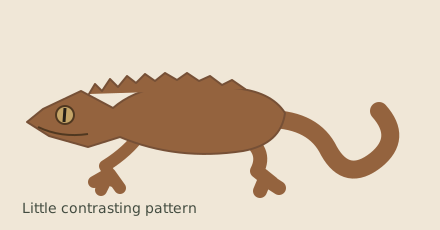
Patternless
Look for little contrastMostly an even body color. Subtle shading or a few spots can still occur.
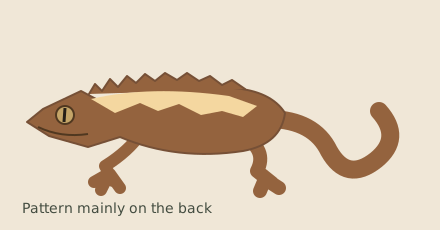
Flame
Look along the backA contrasting back with relatively little pattern on the sides and legs.
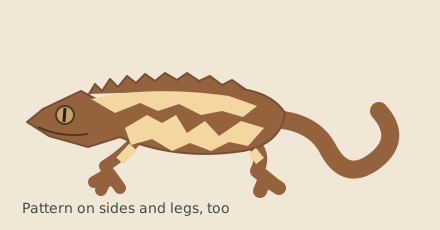
Harlequin
Look at the sides and legsContrasting patches extend beyond the back. “Extreme” describes especially heavy coverage.
Read about Harlequin →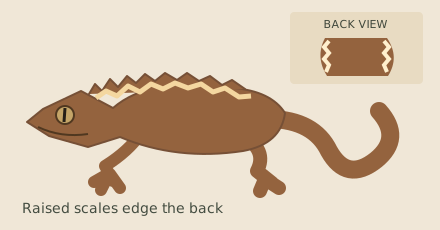
Pinstripe
Look at the edges of the backTwo rows of raised scales run along the back. The inset shows both rows from above; a partial pinstripe has gaps.
Read about Pinstripe →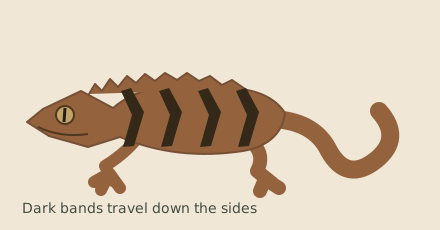
Tiger
Look for downward bandsDark bands travel from the back down the sides. Broken, irregular banding is often called Brindle.
Read about Tiger →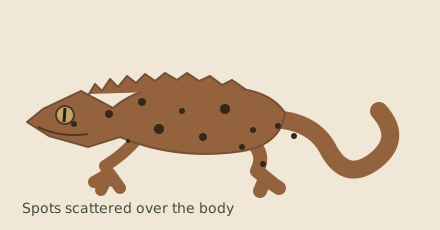
Dalmatian
Look for scattered spotsMultiple spots appear over the body. Spotting can occur together with stripes or other patterns.
Read about Dalmatian →Simplified illustrations, not identification tests. Real geckos vary with age, lighting, and firing state, and features can overlap. A Harlequin can also have Pinstripe and Dalmatian spots. A photo alone cannot prove hidden genetics.
Pattern references: Foundation Genetics (PDF) and Crested Gecko Kaleidoscope (PDF), breeder-authored references. The diagrams isolate visible features rather than guarantee a genetic mechanism.
Next: understand what can be inherited →Understanding a Morph Listing
“Red Harlequin Pinstripe · 100% het Axanthic” may sound like one long morph name. Each part tells you something different.
- Red
- Base colorThe main background color.
- Harlequin
- Body patternContrasting pattern on the back, sides, and legs.
- Pinstripe
- Back detailRows of raised scales along the edges of the back.
- 100% het Axanthic
- Carrier claimClaims a known carrier of one recessive Axanthic copy. The animal does not need to look Axanthic.
“100% het” means claimed certainty that it is a carrier. It does not mean a 100% chance of visual babies. “Possible het” means carrier status is uncertain. Ask for parent and lineage records supporting the claim.
Appearance words tell you what to look for. Inheritance claims need records. Try carrier × carrier in the practice exercise →
Why does the same gecko look different in two photos?
Crested geckos naturally “fire up” to darker or more intense colors and “fire down” to lighter or less intense colors. Lighting and age also change how they appear. Ask for clear photos in both firing states; a shade change does not change the animal’s inherited information.
Morph Terms
Search the full directory, or choose a topic. Some terms describe appearance; others describe inherited traits or breeder shorthand.
Crested Gecko Trait Profiles
Each profile describes the visible features, inheritance model, and available evidence. “Working model” means the explanation is still developing; “Emerging” means early project evidence.